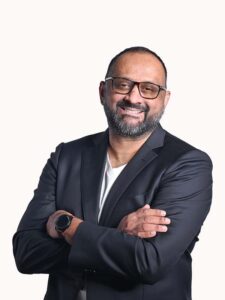
By Alex George, Managing Director, Al Ostad Pallet Factory
2025 was a monumental one for the company my father set up 25 years ago, as we moved into a brand new, purpose-built production facility in Dubai Industrial City after decades in Jebel Ali. It’s a strategic new location for us near Al Maktoum Airport, and right at the hub of the new industrial hub of Dubai South.
As we approach 2026, my thoughts concern upskilling our labour force, ready for the shift towards AI, which is imminent across most industrial sectors. Obviously, this shift must be carefully managed. We don’t want to create too many ripples of concern among our loyal team. But the biggest question for me is: How does one work alongside technology without fearing it?
So next year, we will be looking into helping employee productivity. We’ll begin by introducing tools to assist productivity – so they end up doing more, without extra strain. You might think of it like watching a person do mental calculations and then giving them a calculator. It’s all about enabling our team to solve problems much quicker, and understanding technology as a tool, as an enabler, rather than a hindrance or an enemy.
Of course, we cannot ignore the rise of technology. The integration of IoT (Internet of Things) sensors and GPS tracking allows for real-time monitoring of pallet location, temperature, and load integrity, which improves inventory management and reduces loss. We will continue investigating and researching these trends throughout 2026.
Strategising around macro sectoral challenges
Macro sectoral challenges that always hang over us all include sustainability. We strategise sustainability goals, working with sustainability think tanks within the GCC Harvard University community.
Waste-to-energy is a good example. Since we process wood, we generate a lot of wood waste. So how can we convert it to energy or a byproduct? Bio-charring waste timber (heating wood waste at high temperature to create a type of charcoal) is something we are seriously looking at. It can be used as an agricultural additive, as we can feed the carbon directly back to the soil.
Sustainability is very important for us, since the basic raw material we use is timber. Our environmental impact is a challenge, and we have executed several supply chain modifications like moving from natural forest timber to plantation timber.
The difference with plantation timber is that it’s grown to be cut, and the cycles are relatively shorter to cutting time. But when you chop down 70-year-old forest trees, there is an environmental impact which most companies would try to greenwash.
Planning around supply chain volatility
Supply chain disruptions will also remain a key issue. Most of these potential disruptions are geo-political, and beyond the control of any business owner. A recent crisis created a significant number of issues for us in terms of raw material delivery, but also from an insurance perspective – as insurance rates went through the roof for cargo.
We are aiming to increase resilience with our supply chain, to hedge against any future disruption we may see there. So, keeping a wider supplier base closer to home despite the additional cost is a way going forward – a concept known as “friendshoring” – which I think we will see as a rising trend in the pallet sector.
And figures back this trend. Data from the Centre for Economic Policy Research (CEPR) reveal that more than 70% of European multinationals surveyed by the CEPR are either already shifting or planning to shift production to more ‘politically friendly’ countries.
We are also trying to increase our stock levels, at least until certain global tensions calm down. As a major manufacturer, raw material availability is a big issue for us and can affect our business, so we must keep a close watch on any potential disruptions to our supply chain.
Addressing local challenges
And at a local level, I think regulatory issues need to be addressed. For example, burning wood waste is a secondary source of energy, but we are normally not permitted to run boilers on our premises due to fire risks.
Of course, there are always opportunities for growth. In 2026, we hope to add more production lines, provided we can acquire additional land. And we would like to integrate backward and acquire a mill, to further help ensure raw material stability.
We are also looking at expansion into the northern emirates and south, towards Abu Dhabi. Both these regions are currently being serviced by our Dubai facility, but our clients have multiple facilities in these different emirates. So, we send our products across different emirates and often face delivery challenges. These challenges could be addressed if we can expand our operations into creating manufacturing sites closer to our customer bases in other emirates.