The project will deliver stable round-the-clock clean power and pave the way for Oman’s future energy systems
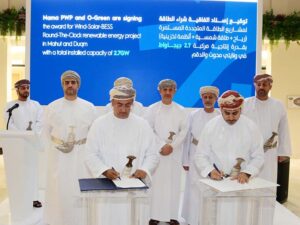
The Sultanate of Oman’s Nama Power and Water Procurement and O-Green celebrated the signing of the award of the Power Purchase Agreement for the Continuous Renewable Energy Project, combining wind, solar and battery energy storage systems in the wilayats (governorates) of Mahout and Duqm, with a total installed generation capacity of 2.7 gigawatts.
The signing ceremony was held under the patronage of HE Sultan Bin Salim Bin Said Al Habsi, Minister of Finance, the Sultanate of Oman.
The award letter was signed on behalf of Nama Power and Water Procurement by Ahmed Bin Salim Al Abri, Chief Executive Officer, and on behalf of O-Green by Mustafa Bin Mohammed Al Hinai, Chief Executive Officer.
The project marks a pivotal step in the evolution of the Sultanate of Oman’s renewable energy strategy, moving from standalone solar and wind projects towards integrated clean-energy systems capable of delivering stable and reliable electricity around the clock.
Strategic platform
It also establishes a strategic platform to support the growth of energy-intensive sectors, including data centres, advanced computing, advanced industries and green fuels.
The project is considered one of the world’s largest hybrid continuous renewable energy projects, combining wind, solar and battery energy storage systems. By integrating renewable resources with advanced storage technologies, the project is designed to provide stable and reliable electricity supply on a round-the-clock basis.
“We are pleased to sign the award of this agreement, which represents an important milestone in accelerating the implementation of continuous renewable energy projects in the Sultanate of Oman, in line with the objectives of Oman Vision 2040,” observed Al Hinai.
“The award of the project to a local developer also presents an integrated model that combines solar power, wind power and battery energy storage technologies to provide stable and renewable electricity supply around the clock,” noted Al Abri.