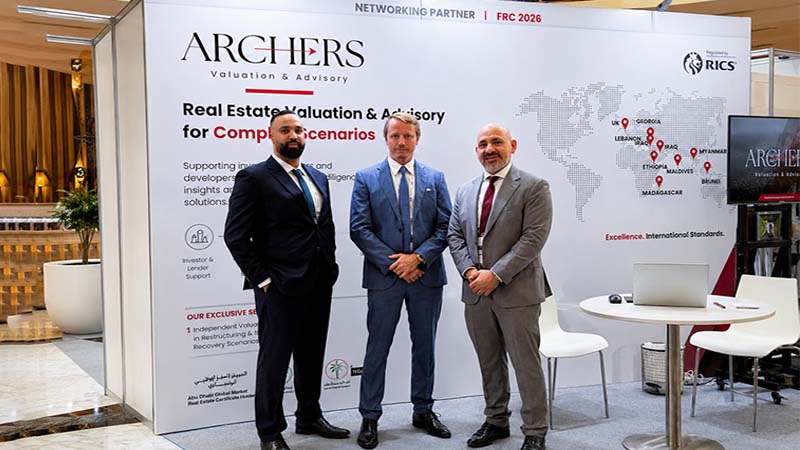
Independent valuation and technical due diligence are increasingly important in complex real estate restructuring
UAE-based Archers, a leading DLD (Dubai Lands Department), ADREC(Abu Dhabi Real Estate Centre) and RICS(Royal Institution of Chartered Surveyors) registered professional services firm, revealed at the recently concluded 4th Annual Financial Restructuring Conference 2020 held in Abu Dhabi that it is currently advising UAE and international lenders, investors, and corporates on how to skillfully navigate the complex economic scenarios and take advantage of the UAE’s well-established infrastructure and business-friendly environment.
Archers unveils specialist briefing papers
At the conference, Archers unveiled two specialist briefing papers that examine the emerging trends and their implications for stakeholders.
The first paper, ‘Independent Technical Due Diligence: A Risk-Based Approach for Investors, Banks, Lawyers and Asset Managers’, explored how technical due diligence is evolving into a broader risk-management and asset-protection exercise across the UAE and regional markets.
The second paper, ‘Why Independent Valuation Is Becoming More Important in Complex Real Estate, Refinancing and Restructuring Situations’, examined how shifting financing conditions and complex transaction structures are increasing reliance on independent valuation advice.
“Periods of market transition often place greater emphasis on independent advice, robust evidence and disciplined decision-making. The themes explored within these papers reflect many of the conversations taking place among lenders, investors, lawyers, restructuring professionals and asset managers,” explained Rus Kolinko, Managing Partner, Archers Valuation & Advisory.
Relative stability
Archers’ in-house research finds that capital continues to enter the UAE market, supported by the country’s relative stability, favourable tax and business environments and safe-haven positioning.
However, investors and lenders are becoming more selective around asset quality, income durability, refinancing exposure and execution risk as regional geopolitical, macroeconomic and financing conditions continue to evolve.
“In restructuring and distressed asset scenarios, stakeholders are often required to make decisions within compressed timeframes while managing uncertainty around operational continuity, lifecycle conditions and future liabilities. Financial and legal due diligence may therefore be supplemented by independent technical reviews to provide additional visibility over the physical asset itself,” observed Kamraan Khan, Partner & Built Environment Lead, Archers Valuation & Advisory.
Archers’ research has revealed this is contributing to stronger demand for independent valuation and technical due diligence advice, especially in refinancing, restructuring, institutional acquisitions and transactions involving complex ownership structures.
M&A transactions
The trend is also evident in selected M&A transactions, portfolio disposals and sale-and-leaseback structures, where independent analysis can support pricing, financing and risk assessment decisions.
The findings noted that valuation uncertainty can become more pronounced when market conditions shift quickly but transactional evidence has not yet fully adjusted.
In this scenario, the papers concluded, technical due diligence is becoming more risk-focused, with investors considering operational resilience, future capital expenditure, regulatory risks, ESG considerations and long-term asset performance alongside compliance matters.
Archers Valuation & Advisory is a UAE-based firm of chartered surveyors providing valuation, advisory and built professional services across Dubai, Abu Dhabi and the wider UAE.

Exclusive interview
As the Networking Partner at the recently concluded 4th Annual Financial Restructuring MENA Conference in Abu Dhabi, Archers launched and presented two specialist briefing papers examining trends, volatilities and winds of change impacting the valuation and advisory issues in the industry.
The conference took place from June 17th and 18th, 2026 at the Conrad Abu Dhabi Etihad Towers Hotel in the UAE capital.
LogisticsGulf.com conducted an exclusive interview with Rus Kolinko, Managing Partner, Archers Valuation & Advisory, following the conclusion of the Conference. The following are excerpts from the interview.
LogisticsGulf.com (LG): For those unfamiliar, please provide us with a brief profile of Archers Valuation and Advisory and the services you provide.
Rus Kolinko (RK): Archers Valuation and Advisory is an independent RICS-regulated valuation and advisory practice providing real estate, plant and machinery, and business valuations across the UAE and wider Middle East.
We advise banks, government entities, institutional investors, insolvency practitioners and private clients, delivering independent valuation opinions that support lending, financial reporting, restructuring, litigation and investment decisions.
LG: The current geopolitical situation, including the regional conflict involving Iran-Israel, the GCC and disruption to the Strait of Hormuz, has undoubtedly affected the wider economy. What immediate implications does this have for the real estate sector in the UAE and the GCC?
RK: The immediate impact is not necessarily reflected in property values, but in confidence. Periods of geopolitical uncertainty naturally delay investment decisions and reduce transaction volumes, while rising shipping costs, insurance premiums and supply chain disruption can increase construction costs.
This has a ripple effect across the market, influencing development feasibility, replacement costs, insurance valuations and ultimately the pricing of future projects.
LG: How would you characterize the real estate industry in the UAE at the present time?
RK: The market is becoming increasingly selective rather than universally strong or weak. Buyers are placing greater emphasis on fundamentals such as location, future supply, rental sustainability and operating costs, resulting in a wider pricing gap between prime assets and secondary stock than we have seen in recent years.
LG: Do you foresee a rebound following a peace agreement, and what are your short and long-term predictions?
RK: A meaningful reduction in regional tensions would restore confidence, which is often the catalyst for investment activity to resume.
The UAE has consistently demonstrated its ability to attract regional and international capital during periods of uncertainty, and I believe its long-term outlook remains positive due to its diversified economy, transparent regulatory framework and continued infrastructure investment.
LG: Does Q4-2026 hold optimism and hope for the industry in the UAE?
RK: If geopolitical conditions continue to stabilise, I expect confidence to improve progressively during Q4. Whether that translates into stronger pricing will depend on transaction volumes, rental market performance and broader economic conditions, but the underlying fundamentals of the UAE market remain favourable.
As with most property cycles, increased market activity is likely to precede any meaningful movement in values.
LG: What appetite exists among potential buyers for new homes and commercial space?
RK: Demand has not disappeared; it has become more disciplined. Buyers are taking longer to commit, carrying out greater due diligence and focusing on long-term value rather than short-term market momentum, particularly within the commercial sector.
At the same time, developers continue to support the off-plan market through attractive payment plans and incentives, although potentially higher construction and financing costs may influence the viability and timing of some future developments, particularly vacant land and development site transactions.
LG: What price levels do you foresee for commercial and residential property going forward?
RK: Rather than focusing on predicting price movements, I think it is more important to recognise that market performance is likely to remain highly asset-specific.
Segments supported by strong underlying fundamentals, such as well-located Grade A office space and prime logistics assets where supply remains relatively constrained, may continue to demonstrate resilience.
Conversely, some secondary assets and development opportunities may face greater pricing pressure as purchasers become increasingly selective and assess future development costs more carefully. Attractive developer incentives and flexible payment structures are also likely to continue supporting activity within the off-plan market.
Over the coming months, rental market performance and occupier demand will provide a clearer indication of whether current pricing levels and investment yields remain sustainable across different sectors.
LG: In your opinion, what might trigger a turnaround for the industry in the UAE and the region?
RK: Confidence remains the single most important driver of the property market. Greater geopolitical stability, improving business sentiment and a more supportive interest rate environment could encourage investors, lenders and developers to deploy capital.
The UAE has also consistently demonstrated an ability to respond proactively through progressive legislation, regulatory flexibility and economic initiatives that support investment, business restructuring and market confidence.
Continued infrastructure investment, together with competitive developer incentives that stimulate demand, further reinforces the market’s resilience.
Collectively, these factors can create the conditions for a sustainable and broad-based recovery rather than a short-term uplift.