20th Logistics Day of the Kühne Foundation at Kühne Logistics University
The result: fragmented, more complex, and more expensive supply chains – but also more resilient ones. And this requires a new style of leadership: executives are no longer optimizing for cost alone but are balancing competing goals such as short-term returns and long-term stability.
Central message
This was the central message at the 20th Logistics Day of the Kühne Foundation, held on 17 April 2026 at Kühne Logistics University (KLU) in Hamburg. More than 200 experts and executives gathered under the theme ‘From Disruption to Direction: Leading the Future of Logistics and Supply Chain Management’ to discuss how companies can navigate uncertainty – and which new leadership competencies are required.
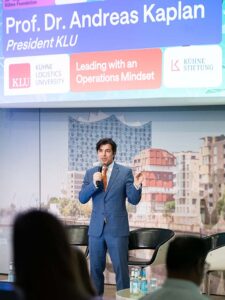
“Disruption is no longer the exception, but the norm. Companies need orientation, judgment, and leadership” stated Prof. Dr. Andreas Kaplan, President of KLU, in his opening remarks. “Logistics has always been good at managing trade-offs: speed versus sustainability, resilience versus efficiency, automation versus human judgment. If anyone is excellently positioned to lead through uncertainty, it is the logistics community,” he continued.
Globalization at a turning point
Prof. John Manners-Bell, founder of the Foundation for Future Supply Chains, London, and CEO of Ti Insight, outlined a paradigm shift in his keynote. “Global supply chains have lifted millions out of poverty and driven economic growth. But the model has come under pressure. Supply chains are increasingly being weaponized,” he conformed.
World trade has fundamentally changed over the past decade through protectionism, trade conflicts, and geopolitical tensions. “Globally integrated supply chains used to be considered the best model. Today they are just one of many options – alongside re-industrialization, nearshoring, or circularity,” added Manners-Bell. The new models are more resilient, but more complex and costly.
Case Study Nike: US$1bn in additional costs
Manners-Bell provided a concrete example with the world’s largest sporting goods manufacturer Nike: tariffs on Chinese exports caused the company approximately one billion dollars in additional costs.
Nike’s share of production in China has been declining significantly for years, while production is being relocated to Vietnam (50 percent of footwear), Indonesia, and the Philippines.
Leadership redefined
Dr. Niklas Wilmking, Executive Director of the Kühne Foundation and former Chief Logistics Officer at DB Schenker, summarized: “It’s no longer primarily about moving goods efficiently, but about translating strategic intent into impact under uncertainty. The best leaders will be those who take accountability for invisible structures and uncomfortable trade-offs. The bottleneck in the future will no longer be computing power, but leadership in terms of prioritization and accountability,” he affirmed.