The corridor forms part of a broader strategy to develop an integrated logistics and customs ecosystem
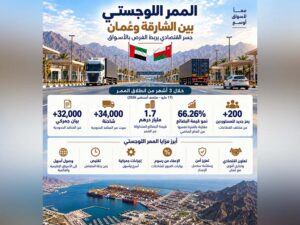
Inaugurated on 17 May 2026, the corridor forms part of a broader strategy to develop an integrated logistics and customs ecosystem linking seaports with land border crossings. It capitalises on Sharjah’s strategic location and its network of ports and border crossings to facilitate imports, exports and re-exports, support growth in trade between the United Arab Emirates and the Sultanate of Oman, and expand access to markets across the region.
The corridor’s latest performance indicators show that total cargo value handled during the initial three months reached approximately AED 1.7bn. Truck movements surpassed 34,000, while processed customs declarations exceeded 32,000.
Compared to the corresponding period last year, cargo value jumped by 66.26%, reflecting growing trade activity and rising demand from the business community for the logistics and customs solutions provided through the corridor.
Integrated sea-land connectivity
The corridor connects cargo flows between ports and logistics hubs via the Khatmat Malaha Border Crossing in Kalba and Al Madam Border Crossing, extending into the Sultanate of Oman. This integrated sea-land model gives businesses multiple options for moving goods, shortens the end-to-end cargo journey, reduces handling stages and procedures, and improves the efficiency of logistics operations.
The corridor forms an interconnected logistics network linking Sharjah’s ports and a number of other UAE ports with Sohar, Duqm and Salalah ports in the Sultanate of Oman via the Khatmat Malaha and Al Madam border crossings.
The network provides the business community with more flexible and efficient routes for moving goods, while strengthening trade connectivity between the markets of the two countries and across the wider region.
Operating the corridor through both Khatmat Malaha and Al Madam gives the system greater operational flexibility, providing two complementary routes for cargo according to its destination and logistics requirements.
Khatmat Malaha also benefits from its proximity to Sohar Port, approximately 70 kilometres away, while Al Madam provides access to the main road network. Together, these connections strengthen integration between sea and land routes and support the continuous flow of trade.
Cargo journeys
This institutional collaboration has significantly reduced customer journey times, strengthened coordination between arrival and departure points, and streamlined the various stages of the cargo journey.
It also gives businesses greater flexibility, enabling them to manage their supply chains with greater efficiency and reliability while reducing the operational burden associated with the movement of goods.
New pathways
“The early results recorded by the corridor during its first months of operation reflect the success of the vision underpinning the project. That vision brings together the efficiency of land border crossings, the speed of customs procedures, and the capabilities of ports and free zones within an interconnected logistics ecosystem that serves the business community and facilitates trade flows,” asserted HE Mohammed Ibrahim Al Raisi, Director of Border Crossings and Entry Points Affairs at the Sharjah Ports, Customs and Free Zones Authority.
He explained that integration across the Authority’s sectors and continuous coordination with the relevant federal and local entities, together with close cooperation with Oman Customs and the competent authorities on the Omani side, have been fundamental to the development of the corridor and to improving its operational efficiency.
Al Raisi added that the growth in trade flows and customs transactions, coupled with new customers joining the ecosystem within a relatively short period, reflects rising demand for the integrated logistics solutions offered by the corridor.
Broader prospects for growth
Looking ahead, Al Raisi said the next phase will focus on expanding the base of companies using the corridor, attracting more shipping companies, shipping lines and logistics service providers, and broadening the range of services and routes available.
These efforts will help drive trade growth, support commercial exchange between the UAE and Oman, and open up wider access to regional markets.
The ongoing expansion of the corridor forms part of the Sharjah Ports, Customs and Free Zones Authority’s efforts to strengthen the competitiveness of Sharjah’s trade and logistics ecosystem by capitalizing on the integration of seaports, land border crossings, customs and free zones.
This integrated approach supports smoother trade flows, expands the options available to the business community, opens new opportunities for investment, and strengthens Sharjah’s contribution to regional and international trade and supply chains.