Key technologies are high-performance powertrains and solutions for software-driven trucks
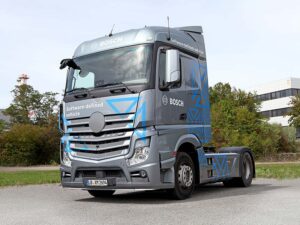
Rising transport demands driven by the growth of global trade, stringent regulatory requirements, and a worsening driver shortage are putting pressure on the industry and driving up total cost of ownership. Bosch’s answer to this is more technology that opens up new economic prospects.
“The heavy-duty commercial vehicle business is a key growth area for us. We aim to double our sales in this segment by the mid2030s,” stated Dr. Markus Heyn, Deputy Chairman of the Bosch Board of Management and Chairman of the Mobility Business Sector, IAA.
Commercial vehicle production
The robust commercial vehicle market is also bolstering Bosch’s business. While global vehicle production is expected to show an overall downward trend in 2026, the heavy-duty commercial vehicle segment (vehicles weighing over six MT) is proving to be more resilient.
Following a strong first half of the year, Bosch expects global truck production to grow moderately by about 1 percent to approximately 3.3mn trucks, and then to 4mn units by the mid-2030s.
On the basis of this forecast and the market uptake of corresponding technologies, Bosch sees the potential to double its heavy-duty commercial vehicle technology sales from today’s more than 4bn Euros by 2035.
Joint Venture
“The company plans to establish a new joint venture with Brakes India and Wheels India, two subsidiaries of the TSF Group, to develop smart actuators for compressed air generation, compressed air treatment, air suspension, and parking brakes.,” added Heyn.
Bosch estimates that by 2030, about one in four newly registered heavy-duty trucks worldwide will be climate-friendly – powered by batteries or fuel cells – with that figure going up to about half by 2035.
The commercial vehicle industry is undergoing a transformation, one that’s not limited to powertrain technology: to improve safety on its roads, the EU has made an increasing number of driver-assistance features mandatory in recent years; the most recent regulations were introduced in July 2026. support the introduction of the new safety standards.
Comprehensive portfolio
With its comprehensive portfolio of systems and sensors, Bosch helps create a complete view of the truck’s surroundings and enhances driving safety and convenience.
Modern commercial vehicles are collecting and processing increasing amounts of data. The ever-expanding range of powertrain, assistance, and automation functions is leading to much greater complexity in electrical and electronic systems.
Software-defined mobility in the trucking business addresses the industry’s most critical factor: total cost of ownership. For fleet operators, the software-defined truck significantly reduces day-to-day complexity, a press statement concluded.