Its software strategy centres on ODATiO, its unified Supply Chain Execution platform
As Saudi Arabia accelerates its logistics transformation under Saudi Vision 2030, the rapid expansion of fulfilment volumes is putting greater pressure on businesses to enhance warehouse efficiency, strengthen inventory visibility and improve operational performance.
The country recorded more than 124mn delivery orders in the fourth quarter of 2025 alone, up 60 per cent year on year, highlighting the scale of demand faced by the Kingdom’s logistics and fulfilment infrastructure.
Expansion
The expansion of the Kingdom’s logistics infrastructure is adding further momentum to this transformation, with 59 logistics hubs being developed across Saudi Arabia. In July 2026, the Saudi Ports Authority signed seven contracts worth nearly SAR 1bn for logistics centres at Jeddah Islamic Port and the Al-Khumra logistics zone, bringing the number of port-based logistics centres to 34, with more than SAR 14bn in total investment.
“Saudi Arabia is a strategic growth market for us, with an opportunity that goes beyond simply expanding automation usage. As logistics operations become more complex, businesses need stronger digital visibility and control to understand where automation can deliver the greatest value and make more informed investment decisions,” asserted Hakim Ramadan, Managing Director, SAVOYE Middle East.
“Our focus is on helping companies establish this digital foundation and then build on it progressively, creating more agile and resilient operations that can respond to changing demand and support sustainable growth,” he continued.
ODATiO
At the centre of SAVOYE’s approach is ODATiO, its unified Supply Chain Execution platform that combines warehouse management system (WMS), transport management system (TMS) and order management system (OMS) capabilities. By bringing these functions together, ODATiO is designed to help businesses orchestrate intralogistics and supply-chain flows across warehouse, transport and order-management processes.
This approach is particularly relevant to sectors experiencing increasing fulfilment complexity and rising order volumes, including eCommerce, third-party logistics (3PL), retail, healthcare and consumer goods. SAVOYE is also identifying opportunities among manufacturing and industrial businesses, where greater inventory visibility, productivity and supply-chain resilience are becoming widely important.
With the software foundation in place, businesses can then introduce automation progressively in line with their operational requirements. Rather than requiring organisations to commit to large-scale automation from the outset, SAVOYE’s phased transformation model enables them to address immediate operational priorities while gradually expanding automation in line with demand, labour availability, throughput requirements and wider business needs.
First WMS implementation
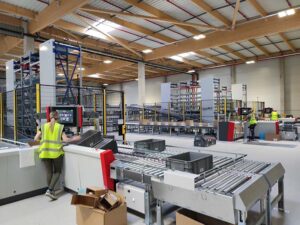
SAVOYE’s work with CJ Logistics and iHerb in Saudi Arabia demonstrates this approach in practice. In 2025, the company deployed ODATiO WMS at CJ Logistics’ fulfilment centre for iHerb at Riyadh Integrated, the Kingdom’s first special integrated logistics zone, marking the first WMS implementation within a SILZ facility.
Building on this experience and its growing focus on the Kingdom, SAVOYE showcased its capabilities at the Saudi Warehousing & Logistics Expo 2026, taking place from September 8 to 10, 2026, in Riyadh.
As Saudi Arabia continues to expand its logistics infrastructure while businesses face rising fulfilment demands, SAVOYE sees significant potential for a model that combines digitalisation, operational visibility and scalable automation to build connected, efficient and adaptable supply chains, a press statement continued.