
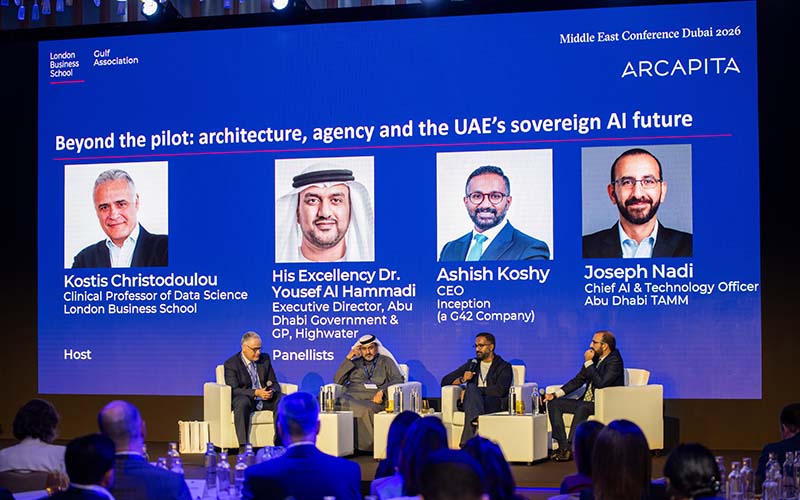
At a time of rapid geopolitical, economic and technological change, senior government leaders, business executives, and academics recently convened in Dubai for London Business School’s (LBS) Middle East Conference 2026.
Hosted in partnership with the Gulf Association and opened with a keynote from HE Fahad Al Gergawi, Undersecretary Ministry of Foreign Trade UAE, the conference examined the region’s expanding role in the global economy.
Conference discussions explored the GCC’s emergence as a globally influential hub for capital, talent and innovation. The programme highlighted the region’s resilience, sustained growth and ability to generate new approaches to long-term value creation.
“Research has shown that diverse perspectives lead to better decision-making. When leaders embrace different viewpoints, they unlock innovation that benefits not just their organisations but society at large as well,” noted Sergei Guriev, Dean, London Business School.
Changing global order
Panels throughout the day explored leadership in a changing global order, the practical impact of artificial intelligence and innovation, the evolution of capital markets and private investment, and the growth of talent mobility and tourism across the GCC.
Speakers included senior regional and international leaders from government, finance, technology and academia. HE Dr. Tariq Bin Hindi, CEO and Board Member at Astra Tech and BOTIM; Yasar Jarrar, Managing Partner, GOV CAMPUS; Haider Khan, CEO, Bayut and dubizzle; Ahmed Abdelaal, CEO, Mashreq; and Omnia Kelig, Group Deputy CEO, Naeem Holding for Investment, were among the contributors. The programme was led by Sergei Guriev.
“We are proud to share this experience with a wider audience each year, and grateful for their continued engagement, which opens “up new possibilities as our community continues to grow,” asserted Evie Boustantzi, President of the Gulf Association, London Business School.